Adult Small Group Personal Training
1049 Taft Street
Rockville, MD
Sports Performance Training
409 N Stonestreet Ave (Unit A)
Rockville, MD 20850
Contact Us:
301-679-1581
Info@prepareforperformance.com
If you are trying to start exercising over 40, but you feel out of shape, busy, sore, or unsure where to begin, you are not alone.
You get home from work already tired.
The commute was long. Your feet hurt. The kids need to be picked up, fed, helped, driven somewhere, or reminded about something for the tenth time. Somewhere in the back of your mind, you keep thinking, “I really need to start exercising.”
But then reality hits.
The gym sounds boring. Running used to be okay, but now your feet do not love it. Group sports are not happening because you have never felt coordinated. And even if you found the perfect workout, where exactly is it supposed to fit between work, commuting, family, and everything else?
So you keep putting it off.
Not because you do not care. Not because you are lazy. Not because you are too far gone.
You just have not found a realistic starting point yet.
A lot of adults hit this exact stage somewhere in their 40s, 50s, or beyond. They want to feel stronger. They want to feel less soft, less tired, and more confident in their body. They may not care about chasing a six-pack or training like they are 22 again. They just want to feel capable.
They want to carry groceries without feeling weak.
They want to get up from the floor without it feeling like a full-body project.
They want to walk, travel, play with their kids, keep up with life, and feel like their body is working with them again.
That is where strength training comes in.
You do not need to love exercise before you start. You do not need to be athletic. You do not need to run. You do not need perfect feet, perfect coordination, or unlimited free time.
You need a simple plan, smart coaching, and a starting point that meets you where you are.
The goal is not to become a “gym person” overnight. The goal is to become stronger, more confident, and more consistent one step at a time.
Most people think they need more motivation to get started.
But for a lot of busy adults, motivation is not the real problem. The real problem is friction.
You may want to get stronger. You may want to feel better in your clothes, have more energy, improve your health, and stop feeling like your body is slowly working against you.
But wanting those things does not automatically make exercise feel easy to start.
Especially when the barriers are real.
If your feet hurt, walking or jogging may not feel like a good option. If you have never felt athletic or coordinated, a dance class, bootcamp, or sport-based activity might feel intimidating. If you are working 40-plus hours per week, commuting, raising kids, cooking meals, and managing a household, your schedule is already full before exercise even enters the conversation.
That is not a character flaw. That is life.
The mistake many adults make is assuming they need to find the perfect activity they love before they can be consistent. But that is not always how it works.
Sometimes consistency starts with finding something that feels doable.
Not exciting at first. Not perfect. Just doable.
A good training plan should lower the barrier to entry. It should fit your current fitness level, respect your schedule, work around aches and pains, and give you early wins so you actually want to keep going.
That is why the best starting point is rarely the hardest workout. It is the workout you can repeat.
Because one brutal workout does not change your body.
But two or three well-coached strength sessions per week, repeated over time, absolutely can.
For this person, strength training is probably the best place to start.
Not running.
Not a random bootcamp.
Not a sport that requires coordination, quick reactions, or feeling athletic on day one.
Strength training.
Here is why: strength training can meet you where you are.
You can start with simple movements. You can work around foot pain. You can move at your own pace. You can build confidence without needing to jump, run, dance, or keep up with anyone else.
And most importantly, strength training directly addresses the thing many middle-aged adults are actually feeling.
They do not just feel “out of shape.”
They feel weaker.
They feel softer.
They feel less capable.
They feel like everyday tasks take more energy than they used to.
That is not something you fix with random exercise. That is something you improve by building muscle, strength, and better movement capacity.
The CDC recommends that adults include muscle-strengthening activity at least 2 days per week, along with regular aerobic activity (CDC, 2025). That matters because strength training is not just about looking more toned. It supports your ability to move well, stay independent, protect your joints, and handle daily life with more confidence.
For middle-aged women especially, this becomes even more important. Research shows that resistance training can help counter age- and menopause-related losses in muscle mass and strength in women ages 40 to 60 (Isenmann et al., 2023). In other words, strength training is not just a fitness option. It is one of the most practical tools for aging well.
And the good news is you do not need to start with complicated workouts.
A good beginner strength plan may include:
Sitting down to a box and standing back up
Learning how to hinge at the hips
Pressing light dumbbells
Pulling a cable or band
Carrying weights
Practicing simple core control
Building lower-body strength without irritating your feet
None of that requires you to be athletic.
It just requires a smart starting point.
The goal in the beginning is not to destroy yourself. It is to leave the session feeling like, “I can do this again.”
That is how consistency starts. And consistency is what changes your body.
A lot of adults describe the same feeling.
“I’m not overweight, but I feel soft.”
“I have a normal BMI, but I do not feel strong.”
“I do not necessarily want to be smaller. I just want to feel more toned.”
That is an important distinction.
Because if your goal is to feel stronger, firmer, and more capable, the answer is probably not more punishment. It is not starving yourself. It is not endless cardio. It is not jumping into the hardest workout you can find just because you feel frustrated.
Most of the time, the missing piece is muscle.
BMI can tell you your weight compared to your height, but it does not tell you how much muscle you have, how strong you are, how you move, or where you carry body fat. The CDC notes that BMI does not distinguish between fat, muscle, and bone mass (CDC, 2025). So you can fall into a “normal” BMI range and still feel weak, soft, or physically unprepared for daily life.
This becomes even more important as we age.
Research shows that muscle mass can decrease about 3 to 8 percent per decade after age 30, with the rate of decline becoming even greater after age 60 (Volpi et al., 2004). That loss of muscle is one reason many adults start to feel like their body is changing even if the scale has not moved much.
This is why strength training matters so much.
Strength training gives your body a reason to build and keep muscle. It helps improve how your body looks, but more importantly, it improves what your body can do. You start to feel stronger going up stairs, carrying groceries, lifting kids or grandkids, getting off the floor, and handling long days without feeling as drained.
For middle-aged women, this is not just about appearance. Research has shown that resistance training can help counter age- and menopause-related losses in muscle mass and strength (Isenmann et al., 2023).
That is why the goal should not be to beat your body into shape.
The goal should be to build it.
Start with simple strength training. Learn the movements. Add weight gradually. Get stronger over time. Let muscle become the foundation for feeling better in your body.
Because feeling “toned” is not just about losing something.
It is about building something.
A lot of adults assume that getting back in shape means they need to start walking more, jogging again, or signing up for some kind of cardio-heavy class.
That can work for some people.
But it is not the only way.
And if your feet hurt, it may not be the best place to start.
Bunions, heel pain, plantar fasciitis, and general foot discomfort can make walking or jogging feel frustrating. You may want to be active, but every time you try to do more, your feet remind you that your body is not ready for that jump yet.
That does not mean you are stuck.
It just means your training needs to be adjusted.
For plantar fasciitis specifically, research shows that strengthening and stretching programs can help reduce pain and improve walking ability (Thong-On et al., 2019). Physical therapy guidance also commonly recommends calf stretching, foot strengthening, proper footwear, and a gradual buildup of activity instead of suddenly adding a lot of walking or running at once (ChoosePT, 2024).
That last part matters.
Many people do not get hurt because walking is bad. They get irritated because they go from doing very little to trying to walk, jog, or exercise aggressively before their feet, calves, tendons, and lower legs are prepared for it.
This is where strength training becomes useful.
A smart strength program can help you train around painful feet while still building the body. You can strengthen your hips, legs, core, back, and upper body without needing to pound the pavement.
Low-impact options may include:
Strength training machines
Dumbbell exercises
Cable exercises
Sled pushes if tolerated
Bike intervals
Rowing if it feels good
Carries with smart loading
Core training
Foot and calf strengthening
Mobility work
The point is not to avoid walking forever.
The point is to build enough strength, tolerance, and confidence that walking becomes easier again.
If your feet are painful, the first goal is not to force yourself through miles of walking just because you think that is what “getting fit” means. The first goal is to find exercises you can do consistently without making things worse.
You do not need to run to improve your health.
You do not need to jog to build strength.
You do not need high-impact workouts to change your body.
You need a plan that respects where your body is right now and helps you build from there.
A lot of adults avoid exercise because they do not see themselves as “athletic.”
Maybe you were never the fast one.
Maybe you were always picked last.
Maybe anything involving a ball, quick feet, rhythm, or group coordination made you feel uncomfortable.
That experience sticks with people.
So when someone says, “You should start working out,” it can bring up old memories of gym class, team sports, or feeling like everyone else knows what they are doing except you.
But strength training is different.
You do not need to be coordinated in the way sports require coordination. You do not need to catch, throw, sprint, dance, or react quickly. You do not need to keep up with a class full of people moving at the same speed.
You need to learn simple movement patterns.
Squat.
Hinge.
Push.
Pull.
Carry.
Step.
Brace.
That is it.
Those movements are not about looking athletic. They are about building a body that works better in real life.
A squat helps you get in and out of chairs.
A hinge helps you pick things up from the floor.
A push helps you press yourself up.
A pull helps your posture, back, and shoulders.
A carry helps your grip, core, and total-body strength.
A step-up helps with stairs, balance, and leg strength.
A good coach does not expect you to walk in knowing how to do all of this perfectly. That is the whole point of coaching.
You start where you are. You use the version of each exercise that fits your body. You practice. You improve. You build confidence through repetition.
Strength training is not about proving you are athletic on day one.
It is about becoming more capable over time.
And for a lot of adults who never felt athletic growing up, that can be one of the most empowering parts of training. You realize your body can still learn. You can still get stronger. You can still improve.
You do not need to be naturally coordinated.
You just need the right starting point, the right progressions, and someone helping you move with confidence.
When life is already full, the answer is not to create a workout plan that requires six days per week, perfect meals, and a completely different schedule.
That might sound good on paper, but it usually fails in real life.
For a busy adult, the better question is:
What is the smallest plan that can still move you forward?
For most beginners, that starts with 2 days per week of strength training.
Not because 2 days is magic, but because it is realistic. It gives your body enough practice to learn the movements, build strength, and create momentum without making exercise feel like another full-time job.
The CDC recommends that adults get at least 150 minutes of moderate-intensity physical activity per week and include muscle-strengthening activity at least 2 days per week (CDC, 2025). The important part is that the 150 minutes can be broken up across the week, and some physical activity is better than none.
That should be encouraging.
You do not need to go from zero to working out every day.
You do not need to spend hours in the gym.
You do not need to punish yourself because you feel behind.
You need a starting point you can actually repeat.
A realistic week may look like this:
Option 1: Strong starting point
2 strength training sessions per week
10 to 20 minutes of easy walking, biking, stretching, or mobility on 1 to 2 other days if your body tolerates it
Option 2: Better if your schedule allows
3 strength training sessions per week
Short walks or low-impact movement on off days
Option 3: When life is chaotic
2 strength training sessions per week
A few short movement breaks during the week, even if they are only 5 to 10 minutes
The goal is not perfection.
The goal is consistency.
If you can strength train twice per week for the next 3 months, that is a real win. That gives you roughly 24 opportunities to practice, build confidence, and start seeing progress.
And once that becomes part of your routine, you can build from there.
That is how long-term fitness works.
You do not start by changing your entire life.
You start by finding the plan that fits your life well enough that you can keep doing it.
One reason the gym feels intimidating is because most people have no idea what they are supposed to do when they walk in.
Do you start with cardio?
Do you use machines?
Do you lift dumbbells?
Do you stretch first?
Do you need to be sore for it to count?
This is where structure matters.
A beginner strength session should not feel random. It should have a clear plan, a safe starting point, and a purpose behind each exercise.
At Prepare for Performance, we want adults to understand that training is not about walking into the gym and getting crushed for an hour. It is about learning how to move, building strength gradually, and leaving the session feeling like you did something productive.
A simple beginner session might look like this:
1. Warm-up
Start with 5 to 8 minutes of easy movement to get your body ready. This could be light cardio, mobility work, or simple bodyweight movements.
The goal is not to burn a ton of calories here. The goal is to prepare your joints, muscles, and nervous system for training.
2. Mobility and activation
This is where you work on areas that often feel stiff or underused, like the hips, ankles, upper back, shoulders, and core.
For someone with foot pain, this may also include calf mobility, foot strengthening, and lower-leg prep.
3. Lower-body strength
This could be a squat variation, box squat, leg press, step-up, or supported split squat.
The exercise should match your current ability. If your feet hurt or your balance is not great yet, you do not need to force advanced movements. You start with what you can control.
4. Hip and backside strength
This could include glute bridges, hip thrusts, Romanian deadlifts, cable pull-throughs, or other hinge-based exercises.
These movements help build the glutes, hamstrings, hips, and lower back, which are important for posture, stairs, walking, and everyday strength.
5. Upper-body push
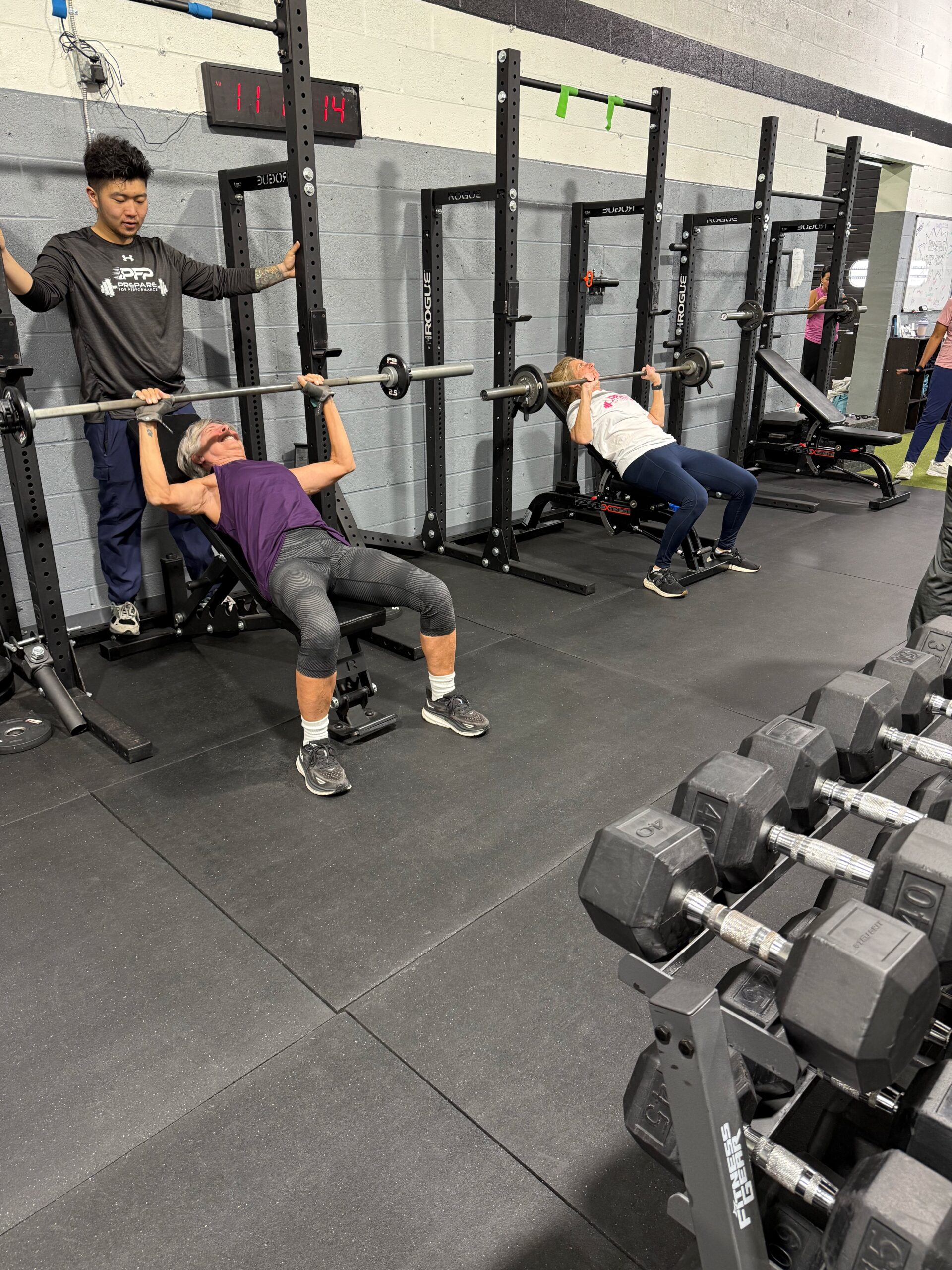
This could be an incline push-up, dumbbell bench press, landmine press, or machine press.
You do not need to start on the floor doing push-ups. You can build upper-body strength with the right variation first.
6. Upper-body pull
This could be a cable row, band row, dumbbell row, or assisted pull variation.
Pulling exercises are important because they help strengthen the back, shoulders, and posture muscles. For many adults who sit at a desk, commute, or spend a lot of time on screens, this matters.
7. Core and carries
Core training does not have to mean endless crunches.
A better starting point may include dead bugs, planks, Pallof presses, farmer carries, or suitcase carries. These exercises teach your body how to brace, control posture, and transfer strength into real-life movement.
8. Optional low-impact finisher
This could be a short bike interval, sled push, rope work, or low-impact circuit depending on the person.
The key word is optional.
Not every session needs to end with exhaustion. Beginners usually do better when they leave feeling successful, not destroyed.
The goal of a beginner strength session is simple:
Learn the movements.
Build confidence.
Get stronger gradually.
Come back next time.
That is what creates progress.
The biggest mistake beginners make is trying to go from doing very little to doing everything at once.
They decide they are finally ready to get in shape, so they go all in.
They try to work out five days per week.
They cut out every food they enjoy.
They sign up for the hardest class.
They push through pain.
They chase soreness.
They do too much too soon.
Then a few weeks later, they are exhausted, sore, frustrated, or hurt. And instead of thinking, “That plan was too aggressive,” they think, “I failed again.”
But that is not failure.
That is a bad starting point.
A good beginner plan should not make you feel like you have to earn your way into fitness by suffering. It should help you build confidence, skill, and consistency.
Especially if you are middle-aged, busy, dealing with foot pain, or coming back after a long break.
You do not need the most intense workout in the room. You need the right amount of challenge for where your body is today.
That means starting with movements you can control.
It means leaving a few reps in the tank.
It means progressing gradually.
It means not turning every workout into a test of how much discomfort you can tolerate.
Strength training works best when it is repeated over time. That is hard to do if every session leaves you so sore that you dread coming back.
A better approach is simple:
Start with 2 strength sessions per week.
Learn the basic movements.
Use weights that challenge you without wrecking you.
Track small wins.
Add more when your body is ready.
That may not sound flashy, but it works.
The goal is not to prove how out of shape you are.
The goal is to build the strength, confidence, and consistency that help you move forward.
One of the most honest things someone can say is, “I know I should exercise, but I find it boring.”
That does not make you lazy.
It makes you human.
A lot of adults struggle with exercise because they are trying to force themselves into something they do not enjoy, do not understand, or do not see the point of yet.
Walking on a treadmill for 45 minutes might feel boring.
Doing random machines with no plan might feel boring.
Going through a workout without knowing whether you are improving might feel boring.
That is why the goal should not be to “just exercise.”
The goal should be to train for something that matters to your life.
Train so stairs feel easier.
Train so your back feels better.
Train so you can carry groceries without struggling.
Train so you can get off the floor with confidence.
Train so you have more energy after work.
Train so you feel stronger in your own body.
When training connects to real life, it becomes easier to care about.
This is also where coaching and structure make a big difference. If you walk into the gym alone and have no idea what to do, it is easy to feel bored, awkward, or overwhelmed. But when someone has a plan for you, teaches you what to focus on, tracks your progress, and helps you improve each week, training starts to feel different.
You begin to notice small wins.
A weight that felt heavy last month feels easier now.
A movement that felt awkward starts to feel smoother.
Your balance improves.
Your posture feels better.
Your clothes fit differently.
You have more energy.
Those wins matter because they give the workout a purpose.
Small group personal training can also help because you are not doing it alone. You still get coaching and structure, but you also get the energy of being around other people who are working on themselves too.
You do not need the gym to be your favorite hobby.
You just need it to feel meaningful enough to keep showing up.
And for many adults, that shift happens when exercise stops being random and starts becoming a clear path toward feeling stronger, healthier, and more capable.
The goal is not to become obsessed with fitness.
The goal is not to spend your whole life in the gym.
The goal is not to train like you are 22 again.
For most busy adults, the real goal is much simpler.
You want your body to feel more reliable.
You want to feel stronger when you carry groceries, lift laundry baskets, move furniture, travel, climb stairs, or get up from the floor.
You want to feel less fragile.
You want more energy at the end of the day.
You want to feel better in your clothes, but you also want to feel better in your body.
That is the part people often miss.
Strength training is not just about the workout itself. It is about what the workout gives back to your life.
When you build strength, daily tasks start to feel easier. When you build muscle, your body has more support. When you improve balance, mobility, and coordination, you start moving with more confidence. When you train consistently, you begin to trust your body again.
That confidence matters.
Because a lot of adults do not avoid exercise because they do not care. They avoid it because they do not feel good at it. They feel behind. They feel awkward. They feel unsure. They feel like everyone else already knows what they are doing.
But you do not need to have everything figured out before you start.
You just need to start with the right plan.
You do not need to love the gym on day one. You do not need to identify as a fitness person. You do not need to be perfectly motivated every week.
You need a place to begin, a coach who can guide you, and a plan that helps you stack small wins.
Over time, those small wins change how you see yourself.
You go from “I am out of shape” to “I am getting stronger.”
You go from “I do not know what I am doing” to “I can handle this.”
You go from “Exercise is not for me” to “This is part of how I take care of myself.”
That is the real goal.
Not becoming a gym person.
Becoming a stronger, more capable version of yourself.
If you are middle-aged, busy, out of shape, dealing with foot pain, or unsure where to start, you are not alone.
You do not need the perfect workout.
You do not need to run.
You do not need to be athletic.
You do not need to train every day.
You need a realistic starting point that helps you build strength, confidence, and consistency.
Here are the big things to remember:
1. Strength training is one of the best places to start.
It is low-impact, scalable, and helps build the muscle and strength many adults lose over time.
2. Feeling “flabby” does not always mean you need to lose more weight.
For many adults, it means they need to build more muscle. A normal BMI does not automatically mean you are strong, lean, or physically prepared for daily life.
3. Foot pain does not mean you cannot exercise.
It may just mean running or long walks are not the best starting point right now. A smart program can work around foot pain while helping you build strength and capacity.
4. You do not need to be coordinated to strength train.
You can start with simple movements like squats, hinges, pushes, pulls, carries, and step-ups. These are coachable skills, not athletic requirements.
5. Two days per week is enough to begin.
You do not need to overhaul your entire life. Start with a schedule you can repeat, then build from there.
6. The goal is progress, not punishment.
The right plan should challenge you, but it should not destroy you. You should leave feeling successful enough to come back again.
7. Exercise becomes less boring when it has a purpose.
Training feels different when you connect it to real-life goals like more energy, better posture, stronger legs, easier stairs, improved confidence, and feeling more capable in your body.
If you are an adult in Rockville, MD and you have been thinking, “I know I need to do something, but I do not know where to start,” Prepare for Performance can help.
If you are ready to start exercising over 40 with a plan that feels realistic, is coached, and is built around your body, this is exactly what our adult small-group personal training is designed for.
You do not have to be in shape before you start.
You do not have to know what to do in the gym.
You do not have to figure it out alone.
We will help you find the right starting point, coach you through the movements, and build a strength plan that fits your body and your life.
If you are ready to feel stronger, move better, and build confidence again, reach out to Prepare for Performance in Rockville, MD to schedule your first visit.
References
Centers for Disease Control and Prevention. (2025). Adding Physical Activity as an Adult. CDC.
Centers for Disease Control and Prevention. (2025). About Body Mass Index (BMI). CDC.
Isenmann, E., Kaluza, D., Havers, T., Elbeshausen, A., Geisler, S., Hofmann, K., Flenker, U., Diel, P., & Gavanda, S. (2023). Resistance training alters body composition in middle-aged women depending on menopause: A 20-week control trial. BMC Women’s Health, 23, 526. doi: 10.1186/s12905-023-02671-y
Thong-On, S., Bovonsunthonchai, S., Vachalathiti, R., Intiravoranont, W., Suwannarat, S., & Smith, R. (2019). Effects of strengthening and stretching exercises on the temporospatial gait parameters in patients with plantar fasciitis: A randomized controlled trial. Annals of Rehabilitation Medicine, 43(6), 662–676. doi: 10.5535/arm.2019.43.6.662
Volpi, E., Nazemi, R., & Fujita, S. (2004). Muscle tissue changes with aging. Current Opinion in Clinical Nutrition and Metabolic Care, 7(4), 405–410.
ChoosePT. (2024). Physical Therapy Guide to Plantar Fasciitis. American Physical Therapy Association.