Adult Small Group Personal Training
1049 Taft Street
Rockville, MD
Sports Performance Training
409 N Stonestreet Ave (Unit A)
Rockville, MD 20850
Contact Us:
301-679-1581
Info@prepareforperformance.com
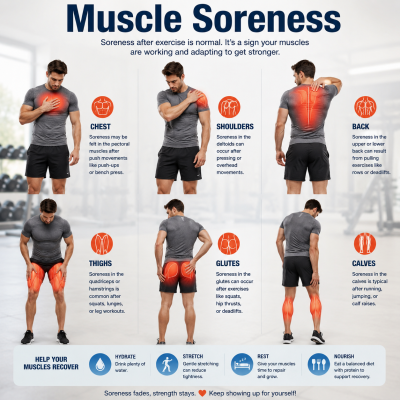
Search any lifting forum and you’ll find the same question asked a hundred different ways: how sore is normal, why won’t it go away, and is it a problem that a workout didn’t leave you sore at all. Usually it’s someone new to strength training who just finished their first real session with a trainer or a new program, and two days later they can barely sit down.
The instinct is to treat that soreness as proof the workout worked. More sore means better workout, right? That belief is common enough that a lot of people chase it on purpose, pushing for the kind of soreness that makes stairs difficult. The research doesn’t back that up, and understanding why matters for anyone building a sustainable training habit.
What you’re feeling is called delayed onset muscle soreness, or DOMS. It comes from small-scale damage to muscle fibers, mostly from eccentric movement (the lengthening phase of a lift, like lowering a weight) or from any movement pattern your body isn’t used to. That damage triggers an inflammatory response, and the soreness itself usually shows up 24 to 72 hours later and clears within about a week.
One old myth worth putting to rest: soreness is not caused by lactic acid buildup. That idea was debunked by Cheung, Hume, and Maxwell in a 2003 review published in Sports Medicine. Lactic acid clears from the muscle within an hour or two of finishing exercise, long before soreness even sets in.
This is the part that surprises most people. A 2013 review by Schoenfeld and Contreras, published in Strength & Conditioning Journal, examined whether soreness actually tracks with muscle growth. It doesn’t, and the paper lays out several separate reasons why.
That last point is the one worth sitting with. If soreness and growth were the same thing, an experienced lifter who stops getting sore from squats would also stop getting stronger from them. That’s not what happens. The body gets more efficient at handling a given stimulus long before it stops adapting to it.
If soreness doesn’t reliably indicate a good workout, training specifically to maximize it isn’t a neutral habit. It can actively work against you.
Soreness measurably reduces strength output and range of motion in the days after it hits. That means a session designed to leave you as sore as possible often comes at the cost of your next two or three workouts, where you’ll be moving less weight through a smaller range of motion than you’re capable of. You’re trading the quality of upcoming sessions for a sensation that was never a reliable growth signal in the first place.
This shows up constantly with new lifters working with an enthusiastic trainer. The first session is brutal, the soreness lasts a week, and by the time it fades enough to train again, momentum and motivation are gone. A program that leaves you unable to move properly for days isn’t more effective. It’s usually just poorly dosed.
Since soreness is an unreliable gauge, the more useful approach is tracking the things training is actually meant to produce:
None of these require you to feel wrecked the next day. A well-programmed session can absolutely be effective without leaving you sore at all, especially once your body has adapted to the exercises in your program.
Soreness is a normal and expected part of starting something new or increasing intensity, even if it isn’t something to chase. When it does happen, a 2018 meta-analysis by Dupuy and colleagues, pooling 99 studies on post-exercise recovery, found the most effective interventions were massage and cold-water immersion, with active recovery and compression garments a step behind those.
What doesn’t help much, despite being common advice: stretching before a workout to prevent soreness, and most over-the-counter approaches beyond basic pain relief.
Ordinary DOMS is a dull, diffuse ache that affects a whole muscle group and gets steadily better day by day. It is not the same as sharp, localized pain, pain that gets worse instead of better, or soreness that hasn’t improved after a week.
Dark urine, significant swelling, or severe weakness following an unusually intense or unfamiliar workout are signs worth taking seriously and getting checked out. Rhabdomyolysis, a serious breakdown of muscle tissue, is rare, but it happens most often after extreme, unaccustomed exertion, which is exactly the kind of session that also produces the worst ordinary soreness. When in doubt, treat pain that doesn’t fit the normal DOMS pattern as a reason to see a doctor rather than push through.
Soreness is a normal side effect of doing something new or harder than usual, not a scoreboard. It fades as your body adapts to a given exercise, which is exactly the point where consistency starts paying off, not the point where the exercise stops working. Training to maximize soreness on purpose usually costs you more in the following week than it gives back.
If you’re newer to lifting and dealing with soreness that feels like too much, that’s worth mentioning to whoever is programming your training. A good coach adjusts volume and intensity based on how you’re recovering, not just how sore you were able to make you.
Want a training program built around actual progress instead of guesswork?
Visit trainwithpfp.com and let’s build a plan that’s dosed correctly from the start.
References
Cheung, K., Hume, P. A., & Maxwell, L. (2003). Delayed onset muscle soreness: treatment strategies and performance factors. Sports Medicine, 33(2), 145-164.
Schoenfeld, B. J., & Contreras, B. (2013). Is postexercise muscle soreness a valid indicator of muscular adaptations? Strength and Conditioning Journal, 35(5), 16-21.
Sikorski, E. M., Wilson, J. M., Lowery, R. P., et al. (2013). Changes in perceived recovery status scale following high-volume muscle damaging resistance exercise. Journal of Strength and Conditioning Research.
Tee, J. C., Bosch, A. N., & Lambert, M. I. (2007). Metabolic consequences of exercise-induced muscle damage. Sports Medicine, 37(10), 827-836.
Dupuy, O., Douzi, W., Theurot, D., Bosquet, L., & Dugué, B. (2018). An evidence-based approach for choosing post-exercise recovery techniques to reduce markers of muscle damage, soreness, fatigue, and inflammation: a systematic review with meta-analysis. Frontiers in Physiology, 9, 403.
Hyldahl, R. D., & Hubal, M. J. (2014). Lengthening our perspective: morphological, cellular, and molecular responses to eccentric exercise. Muscle & Nerve, 49(2), 155-170.